
Capturing data at one station is straightforward. The challenge is bringing many distributed stations, different field operators and multiple observation times into one traceable data flow.
Distributed stations leave gaps in manual records
Fuel-station networks are often large and dispersed, with sites located tens of kilometers apart. Manual transcription requires site-by-site inspection, and any anomaly may trigger another trip. A mismatch in recording conventions, timestamps or locations makes later review even harder.
The project therefore needs more than additional forms. Every field sample should carry verifiable location, time and device information, then reach the platform directly from the field.

Selection must survive field verification
During selection, the customer's criteria are direct. The device must complete positioning, recording and transmission in one field visit. Any anomaly should be traceable through the original record instead of requiring another site visit.
The terminal must therefore combine all-constellation centimeter-level RTK, NTRIP CORS correction, full-network 4G and direct platform connectivity. A temporary network change should affect only transmission timing, not the continuity of field capture.
Capture once and pass once; record directly in the field and return data to the platform; resume synchronization after reconnection instead of treating repeat inspections as normal.
A field terminal for positioning, recording and transmission
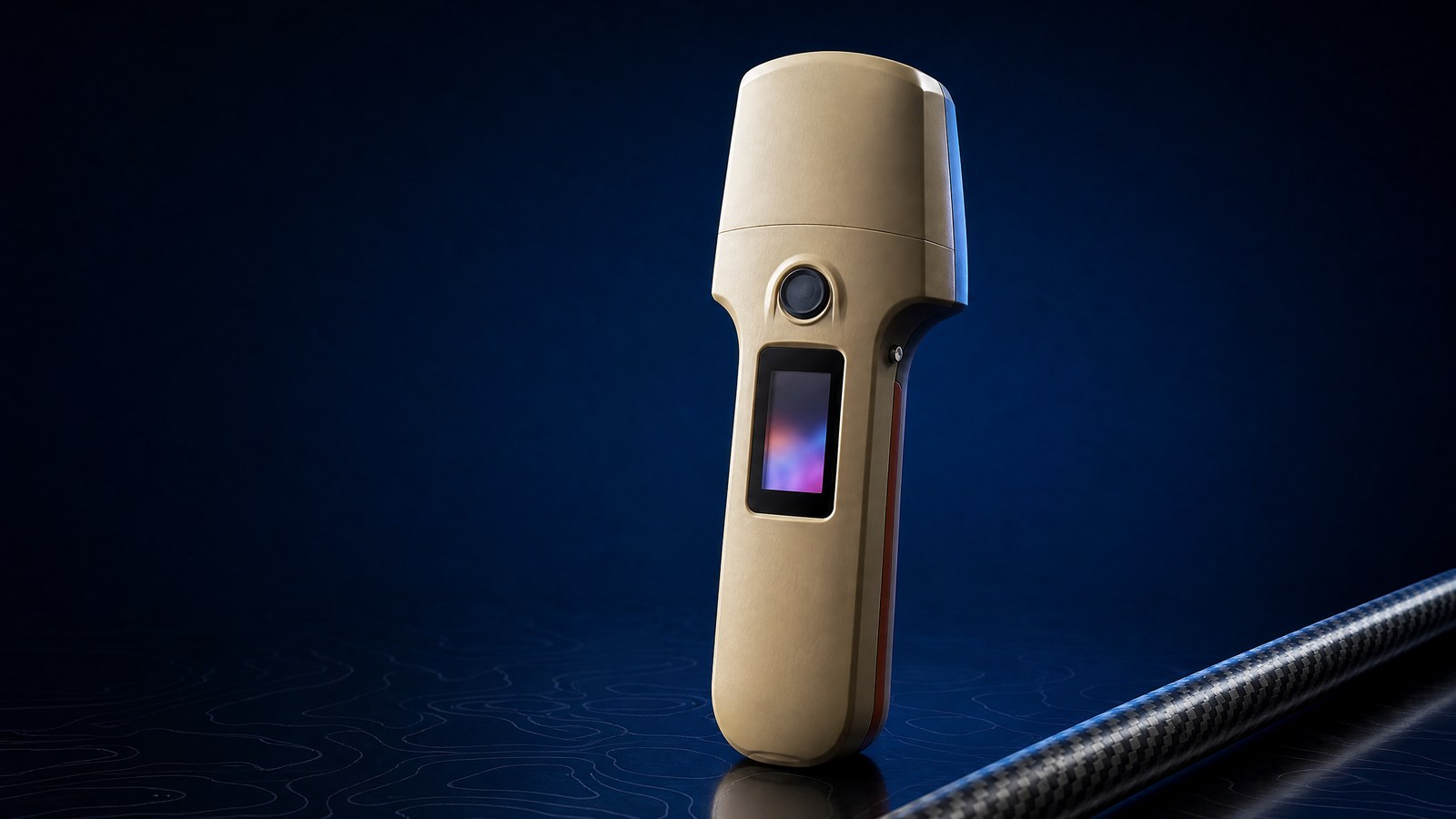
The H13 field collection terminal provides all-constellation centimeter-level RTK and NTRIP CORS correction, with fixed-solution convergence in less than 10 seconds. RTK operation lasts at least 20 hours. IP67 protection and a 2 m drop rating support routine outdoor inspection around fuel stations. Its 1-20 Hz update rate covers different operating practices, with 10 Hz as the default.
Full-network 4G connectivity links the terminal to the platform for direct transmission of location and field records, reducing manual import. For projects that require a dedicated hardware form factor, the MG20 collection module is also available.
MG20 customizable collection module for existing equipment
MG20 Customizable RTK Module PCBA
UM980 + 4G + Bluetooth; 1,408 channels with NebulasIV; 5-30 V power input.
OEM/ODM customization supports direct integration into an existing field architecture and reduces duplicate development.
When a project already has an industrial host, sensors or a dedicated terminal, MG20 can be embedded as a PCBA. When a standardized field tool is required quickly, H13 can serve directly as the handheld collection terminal.
Three field steps that are easy to mishandle
- Station and observation-point drift: verify local coordinates using the station location or map reference, then cross-check the field single-point position and observation time before passing the record downstream.
- Inconsistent elevation conventions: fix pole height, antenna height, geoid model and coordinate system in the operating procedure so the same device does not produce systematic differences between operators.
- Data gaps caused by network interruption: store field records locally and resume synchronization after reconnection. A temporary communication failure does not interrupt field work or require duplicate capture.
The same field-data approach extends to other projects
The same operating model applies to transportation, outdoor engineering and other scenarios that require mobile capture and traceable high-precision position records. The essentials remain stable acquisition at the terminal, reliable local storage and transmission when network conditions permit.

From a single sample to continuous traceability
The key change is not simply adding a device. It is closing the gap between field operations and back-office management, so terminal records correspond to platform data, anomalies can be traced to position and time, and repeated manual entry between systems is no longer required.
For comparable projects, define station distribution, capture frequency, coordinate system and platform interfaces first, then validate terminal and module configurations through a focused field pilot.