Requirement specification
If form factor is given without interfaces and working conditions, rework appears at the trial-production stage.
The key to GNSS terminal OEM/ODM customisation is not whether it can be done, but whether requirements, acceptance and volume are each defined once, clearly.
If form factor is given without interfaces and working conditions, rework appears at the trial-production stage.
Without defined test items and pass/fail criteria, the two sides understand “qualified” differently.
Small batches pass but consistency drops after scaling, usually because process and incoming-material specifications were not locked.
Main control and communication: UM980 + 4G + Bluetooth; channels 1408 (NebulasIV); supply range 5-30V.
Supported frequencies: BeiDou B1I/B2I/B3I/B1C/B2a/B2b, GPS L1/L2/L5, GLONASS L1/L2, Galileo E1/E5a/E5b/E6, QZSS L1/L2/L5/L6.
RTK accuracy (RMS): horizontal 0.8cm+1ppm, vertical 1.5cm+1ppm; cold start <20s.
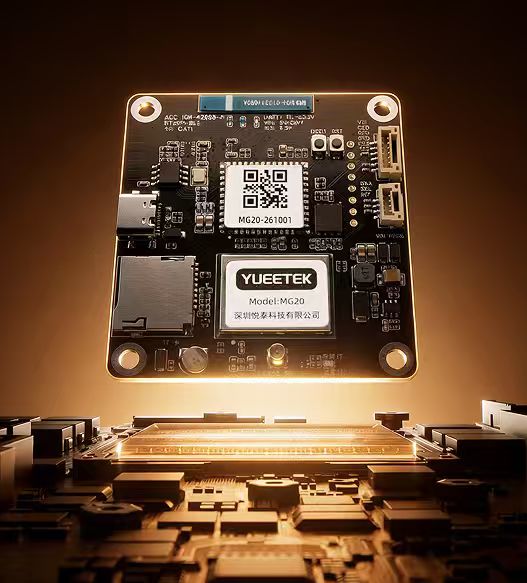
Current product models (checked 20260929): handheld H13 (all-constellation, multi-frequency professional RTK handheld terminal, Pro tier only) / H11 (single-BeiDou, dual-frequency and Pro versions; overseas H11 ProEU for Europe and H11 ProEN for North America; brand name “BeiDou Xingtan”); module MG20 (RTK customizable PCBA); antennas SK6640 / SK6608. The H11 Pro and H13 share the same module (1408 channels, NebulasIV).
List functions, interfaces, working conditions and certification requirements in one pass.
Confirm performance and assembly through prototype measurements.
Lock key materials and inspection criteria, then discuss volume and lead time.
Need to confirm interfaces, working conditions and volume-production specifications per project? Contact YUEETEK.